

Pre-Nursery Program Classes
KLearning Kids help children develop their brains in a number of ways. One of the most important ways is by providing a stimulating and engaging learning environment that encourages children to think critically and creatively. This can include a variety of activities and experiences, such as hands-on projects, problem-solving exercises, and opportunities for exploration and discovery.
In addition, we provide access to a range of educational resources and trained educators who can support children as they develop their cognitive abilities and learn new skills. Overall, a good education can help children develop the cognitive skills and abilities that are essential for success in school and in life.
Core Developmental Focus Areas
In our Pre-Nursery classes, every activity is purposeful and designed around key developmental milestones:
Early Social & Emotional Skills:
Helping children make friends, share toys, and learn cooperative play in a safe, guided group setting.
Fostering independence, confidence, and emotional expression away from parents.
Fine & Gross Motor Skills Development:
Engaging toddlers in gripping crayons, stacking blocks, and early tracing activities (such as standing and sleeping lines) to strengthen hand muscles.
Outdoor and indoor physical games that build balance, coordination, and spatial awareness.
Language & Phonics Introduction:
Introducing multi-sensory phonics, rhymes, storytelling, and picture flashcards to expand vocabulary and listening comprehension.
Cognitive Curiosity & Play-Based Learning:
Sparking curiosity through color identification, shape sorting, puzzles, and sensory play.
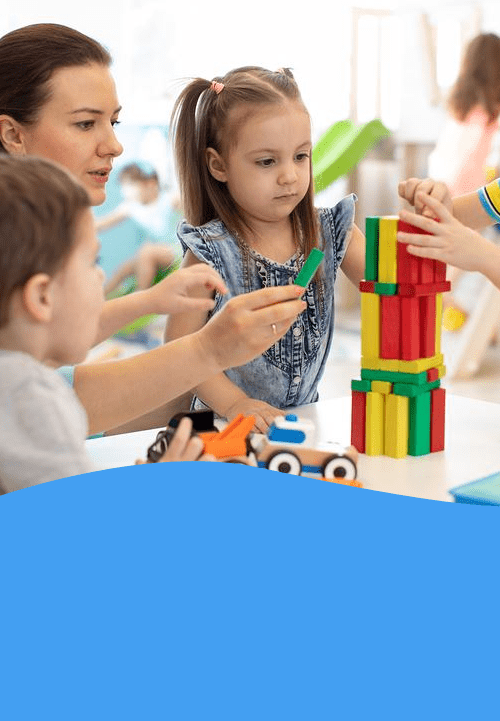
Pre-Nursery Class Curriculum (Age 2.5–3 Years) aligned with the National Education Policy (NEP 2020) Foundational Stage / ECCE (Early Childhood Care and Education) framework. This curriculum integrates experiential, play-based, and toy-based learning methodologies.
1. Physical & Motor Development
Gross Motor Skills:
Enhancing balance, coordination, and spatial awareness through free play, running, jumping, hopping, and simple indoor/outdoor obstacle courses.
Yoga and physical movement songs to build core body strength and body awareness.
Fine Motor Skills & Pre-Writing:
Finger dexterity exercises using chunky crayons, safe-grip tools, stacking blocks, and sorting beads.
Introduction to basic pencil control and pre-writing strokes through guided tracing activities (such as vertical standing lines and horizontal sleeping lines).
Sensory tactile play using sand tracing, clay modeling, and peg boards.
2. Language & Communication Development
Listening & Speaking (Oral Literacy):
Expressing needs, thoughts, and feelings in simple sentences; expanding vocabulary through interactive daily conversations.
Storytelling sessions using puppets, picture books, and visual flashcards to build listening comprehension and imagination.
Action rhymes, rhythmic poetry, and vernacular/Hindi/English conversational prompts to build vocal expression.
Early Phonics & Pre-Reading:
Multi-sensory introduction to sounds using phonetic games, auditory matching, and picture flashcards.
Recognizing beginning sounds and matching letters with visual objects to build early phonemic awareness.
3. Cognitive & Mathematical Development
Pre-Math & Logic Readiness:
Sorting and classifying objects by color, size, shape (circle, square), and texture.
Concept building of basic spatial awareness (e.g., big/small, in/out, up/down).
Pattern recognition and simple matching games using concrete objects and puzzle pieces.
Experiential Problem-Solving:
Curiosity-driven exploration through simple block building, sorting rings, and age-appropriate toddler mazes (e.g., bee and dog mazes) to encourage logical thinking.
4. Socio-Emotional & Ethical Development
Socialization & Empathy:
Encouraging sharing, taking turns, and cooperative play in a safe, nurturing group setting.
Developing emotional self-awareness by helping children recognize and express basic feelings (happy, sad, excited).
Self-Help & Independence:
Building independence in daily routines such as packing bags, washing hands, eating independently, and tidying up play materials.
Fostering positive classroom habits, respect for peers, and gentle manners during circle time.
5. Aesthetic & Cultural Development
Art, Craft & Creative Expression:
Finger painting, sponge printing, tear-and-paste craft activities, and scribbling with non-toxic colors.
Creative exploration through role-play, dressing up, and imaginative play zones.
Music & Movement:
Exploring rhythm, sound pitch, and tempo through musical instruments (shakers, tambourines) and movement songs.
Why Choose KLearning Kids Pre-Nursery?
Experienced & Caring Educators: Led by founder Pooja Kapoor and a team of compassionate teachers trained in early childhood care.
Small Class Sizes: Ensuring individual attention and a watchful eye on every child’s safety and progress.
Safe & Hygienic Center: Located at
9/45, Subhash Nagar, New Delhi-110027, featuring child-friendly furniture, non-toxic toys, and secure premises.Seamless Blend with Home Learning: Parents receive regular updates and access to our expert-designed printable worksheet resources for reinforcement at home.
Frequently Asked Questions (Pre-Nursery FAQs)
Q: What is the exact age eligibility for Pre-Nursery?
A: Children between 2.5 and 3 years old are ideal for our Pre-Nursery program.
Q: How do you help children cope with separation anxiety?
A: Our teachers use gentle, patient, and engaging transition techniques, welcoming games, and short settling-in hours to make children feel completely at home.
Q: How can I book a visit to the Subhash Nagar center?
A: You can call us directly at 9873362252 or fill out the trial booking form on our homepage to schedule a campus tour with Pooja Kapoor.
Key Pedagogical Approach under NEP 2020 at KLearning Kids:
Play-Way & Activity-Based: Learning is driven by joyful games, exploration, and hands-on manipulation rather than rote memorization.
Multi-Sensory Integration: Combining visual, auditory, and kinesthetic tools (such as flashcards, tracing worksheets, and tactile toys) to cater to diverse learning styles.
Continuous Holistic Assessment: Tracking developmental milestones across motor, cognitive, and social domains rather than formal examinations.